

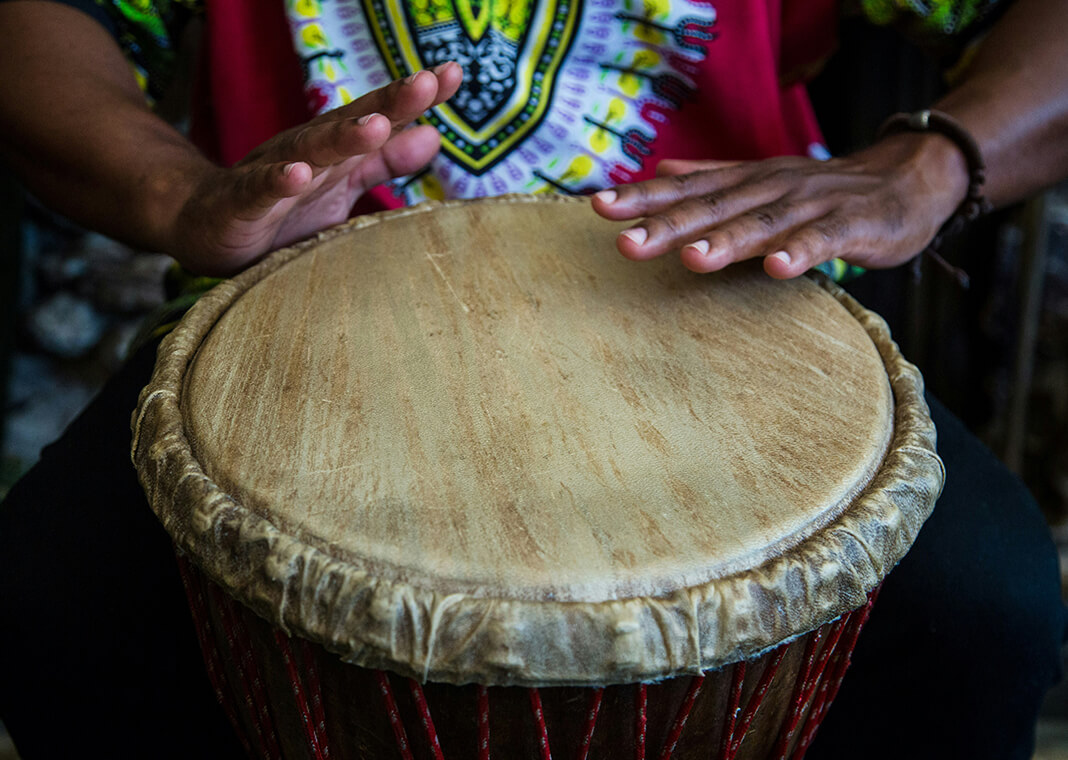

I am a djembefola (one who plays djembe drums). I learned to play these drums (also known as talking drums) at the age of ten. An older man who lived in my neighborhood in the South Bronx had studied African drumming, and he was kind enough to hand down all that he knew about this tradition. To this day, I enjoy every opportunity to play my djembe drums, especially on Wednesday nights when I join thirty to forty drummers in an outdoor drum circle in Florida. We come together with a shared passion for making music. It’s that simple.
To me, the drum circle is a reminder of the power of diversity. In the circle there are people of all ages from very different backgrounds—some Black, some White, some Latino, some highly skilled, and some beginners. We hang out together for three hours. There is no tension. No judgment about who plays better than the other. Each of us joins together to create a wonderful display of multiculturalism at its finest. We drum ourselves into oblivion, all of us sharing the same single-minded objective of making music.
African drumming is hypnotic, something that can be an out-of-body experience. I improvise staccato rhythms as other drummers are simultaneously creating unrehearsed beats. Strangely, it sounds harmonized. When I hear talking drums I think about my purpose on earth as a Black man. As a husband, father, grandfather. As a retired senior officer in corporate America who led diversity. And as a Catholic. When I am participating in the circle, I know I matter. My rhythms matter. My improvisations matter. What my talking drum says matters. And in this communal call-and-answer where we bring our entire essence into the conversation—conversation involving drumheads, hands, hearts, personal histories, and minds—I feel that I am more than enough.
In the drum circle no one fights. No one talks politics. No one’s faith is questioned. We just play drums.
Drumming is powerful. It’s magnetic and inviting. It soothes our pain. It erases our anxieties. In the drum circle no one fights. No one talks politics. No one’s faith is questioned. We just play drums.
How is it that a drum circle can bring together an array of people from different backgrounds and create the kind of cooperative effort the 106th Mayor of New York City, David Dinkins, who, in 1989, was the first African American to serve as mayor of New York City, referred to as “the gorgeous mosaic of God’s creations”? It happens because while the drums are playing, we release our hearts and souls unabashedly, without fear of judgement. Each drummer has a different beat. Each dancer moves their body uniquely.
Oh yes—one more thing—women, men, and children run to the center of the circle and dance to the rhythms while I smack my drums to accentuate the movement of their bodies. The team play between the drummers and dancers is liberating. Exhilarating.
When I am playing my djembe drum, I am also keenly listening and paying close attention to the rhythms of the other drummers. I am constantly seeking opportunities to blend the beats that I hear in my own mind with the rhythms they are putting out into our collective energy. With my ears I search for the disruptions and the offbeats. When I find them, I insert my own message into those openings. This is when the drums really start talking to one another. To the uninitiated, the pitter-patter of talking drums may sound a bit chaotic. In many ways, like the sound of a group of excited teenagers chattering as they climb aboard a field-trip bus, it is. I call it rhymical chaos as created by a diverse set of people from all backgrounds and highlighting the beauty of diversity. I think to myself, This is where we can find God. With so much stuff going on in the world today that prevents us from talking with one another, listening to talking drums lets us hear the joy and pain carried by our brothers and sisters.
Drumming begs the questions, How do we find hope in the pitter-patter? Are our drums the voices of the voiceless? Or are there better questions? Can our drums speak for the ones whose voices are not heard? Does our drumming make us better listeners, better able to be the voices of those who have been silenced?
—Excerpted from This I Know: Principles for a Life of Faith and Optimism by Anthony P. Carter
Photo by Luz Mendoza on Unsplash.