


Jesus promoted peace. He said at the Last Supper, “Peace I leave with you; my peace I give to you.” (John 14:27) Then, after the Resurrection, Jesus’ first words to the disciples were, “Peace be with you.” (John 20:19) Although it may at times seem that we are powerless to stop wars, violence in our cities, or even arguments or conflicts in our families and communities, there are many ways that we can work for peace. Here are some about which I have been thinking lately.
We can pray for peace. Pope Leo XIV asks for the faithful to continue to pray for peace, in order to prevent suffering to innocent lives and to promote dialogue that can lead to a lasting peace. There are many prayers for peace that others have already written, or we can go to Eucharistic Adoration, pray the Rosary, or pray for peace during intentions at Mass, to name just a few ideas.
We can engage in dialogue with others peacefully. Dialogue that sincerely listens to another person with a desire to understand and not only to change another’s view can promote peace. Perhaps we can say to someone who holds views opposed to our own, “I’d like to understand your point of view and just listen for a while, to try to understand why you believe as you do.” Listening to others with curiosity need not mean agreement with their views, but it promotes non-violent dialogue across differences.
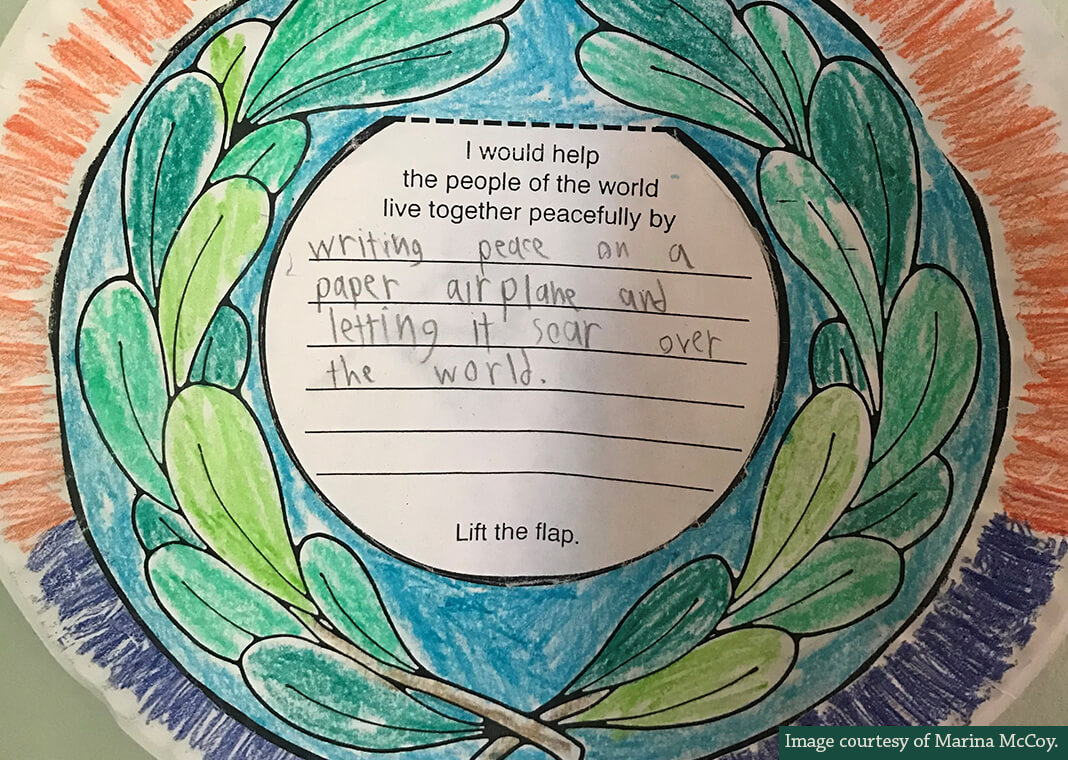
We can teach our children to care for peace. When our children were very young and attended a Catholic elementary school, they were each invited to decorate paper plates with an image and a way that they might choose to work for peace. My son wrote, “writing peace on a paper airplane and letting it soar over the world.” This paper plate still hangs on my wall today as a reminder to work for peace in our lives.
We can forgive or reconcile with others. Reconciliation with others is a two-way street, one in which both parties must participate, but we can invite reconciliation where relationships are broken. Sometimes the restoration of relationship is not desirable, but in those cases, we can still forgive and find our own inner peace.
We can learn more about how the Church advocates for justice, because justice and peace go hand in hand. The U.S. Conference of Catholic Bishops has online resources that remind us of key ideas of social justice, such as the life and dignity of the human person and the option for the poor and vulnerable. Maybe we want to choose one priority for which to work, whether that means serving at a food pantry, visiting someone in prison, or advocating for better laws. When we work for justice in non-violent ways, we set the conditions for a lasting peace.