


Editor’s note: Throughout July, we’re hosting 31 Days with St. Ignatius, a month-long celebration of Ignatian spirituality. In addition to the calendar of Ignatian articles found here, posts on dotMagis this month will explore the theme of “Finding God in the Unexpected.”
I had one goal in traveling to Vienna for the first time. I wanted to see the organ pipes in St. Stephen’s Cathedral carved by my grandmother’s grandfather. Before the First World War, my great-great-grandfather, a carpenter from Slovakia, helped create a magnificent instrument in the centuries-old church.
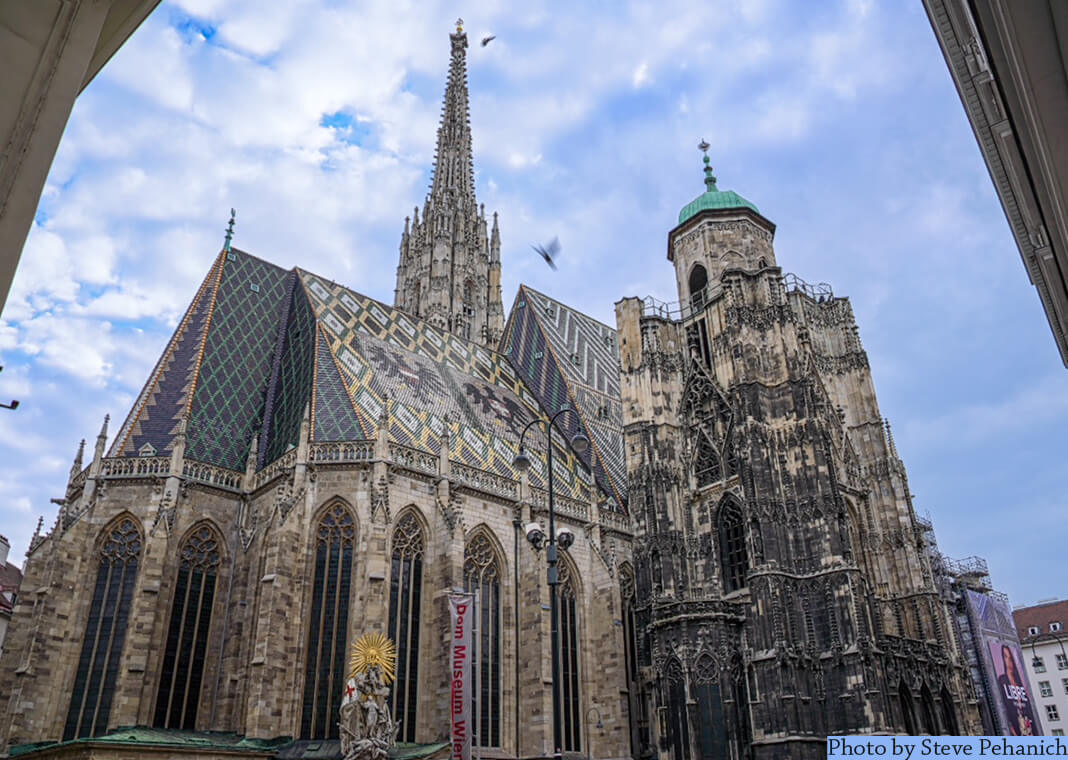
We arrived in Vienna and headed straight to the large square surrounding St. Stephen’s. It’s impossible not to pause to marvel at the mosaic-tiled roof. Still, I made a beeline to the entrance to see those pipes that my relatives had described in stories time and again.
Now we might presume to find God in a cathedral, but in Europe it’s easy to forget that due to a structure’s historical significance. I had no expectation of a personal encounter with God as I rushed to see a family “heirloom.”
Once inside St. Stephen’s, I saw gold-painted gates, common in many churches in Europe. They preserve the sanctity of sacred spaces from noisy tourists. I walked up to those gates and noticed pews full of people and a vested priest at the altar. What happened next was far beyond anything I expected.
Despite the Mass being in German, I knew immediately where we were in the liturgy. The priest uttered a short phrase, and the people stood. The priest blessed them, and me too, as I made the Sign of the Cross. Then a very personal experience unfolded.
Before I tell you what it is, I need to explain that my favorite liturgical moment all year is the sung “Alleluia” during the Easter season. After 40 days of fasting and then the long Triduum services, that refrain thrills my heart.
That’s why I began to cry at the privilege of responding to the priest’s antiphon (in German) by singing (in English), “Thanks be to God, A-lle-lu-u-ia! A-lle-e-e-e-e-lu-u-u-ia-a!”
With my hands on the golden gates, my heart swelled. God was right here in front of me in this assembly.
But that’s not all. Suddenly the church filled with loud organ music. Sound reverberated through my body! I had not anticipated hearing the organ, and I cried tears of uncontrollable joy. I imagined my ancestors celebrating in a heavenly hymn with me.
I stood transfixed in the presence of God, who knows my deepest desires even before I do. I looked up at the pipes and, yes, many, if not all of them, have been replaced over the years. But I am sure my great-great-grandfather’s initials are carved somewhere in that lofty space, as the family provenance indicates.
St. Ignatius taught that all human experience is a canvas for encountering God. The Divine Majesty was working with me during that vacation, especially in that church. God is full of surprises.
Two days later, we rose at 6 a.m. to make the earliest morning Mass at St. Stephen’s, because our non-Catholic traveling companions wanted to hit the road early. Again, the organ swelled, and I was surrounded by a sanctuary full of God’s extended family and my family in heaven. This was my heritage and my inheritance. I was home.
Today in 31 Days with St. Ignatius, read Pray for the Grace by Rebecca Ruiz. Share the link to this or any article from our site with the hashtag #31DayswithIgnatius on your favorite social media channels.