


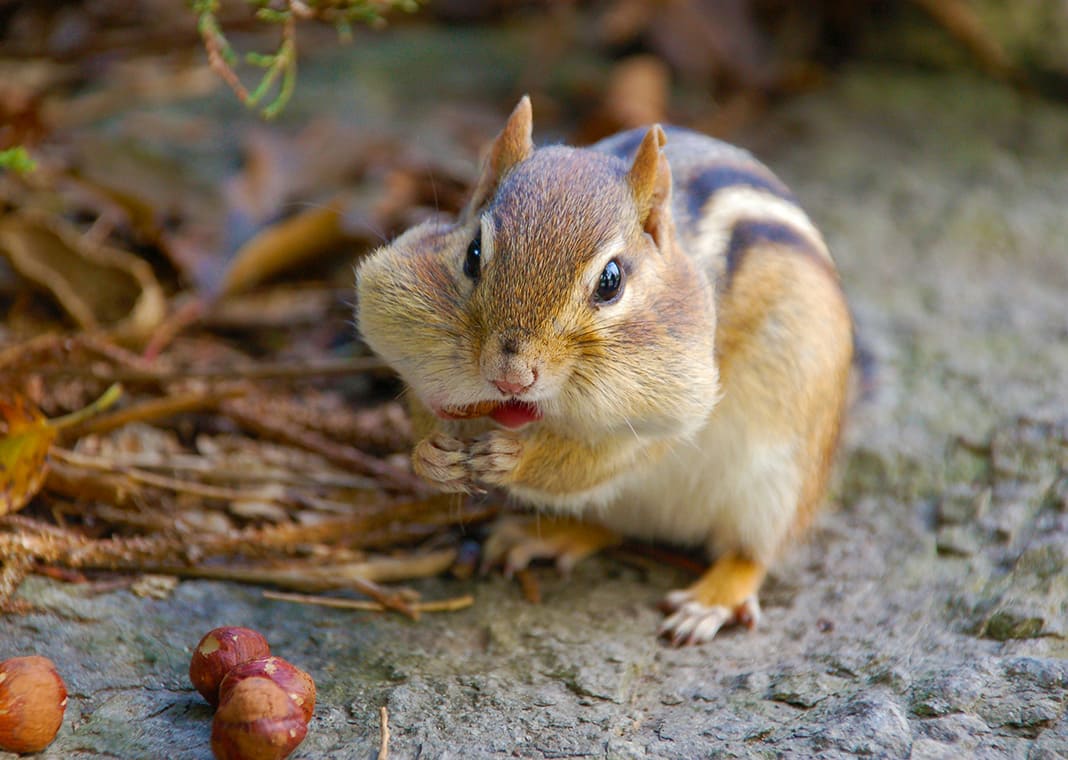
This past summer while on retreat I sat outdoors at breakfast, looking out at a beautiful garden of flowers and a blossoming tree near a statue of Mary. On the tree was a bird feeder attached to a branch. Beneath it I saw a chipmunk gathering seeds. There was a chickadee eating above the chipmunk, and some of the seeds fell to the ground. As the seeds fell, the chipmunk scooped them up into his mouth. I watched the chipmunk’s cheeks grow fatter and fatter with seeds—perhaps much like the Ignatian idea of storing up consolation now for a time of desolation later, I thought.
My retreat left me feeling much like that chipmunk, having received many good gifts that mostly only required of me that I be there to receive them. God does all the work, and I’m just there to pay attention and to receive. When I was younger, prayer was a gift then, too, but it felt like a lot more effort on my part. For example, I engaged in a great deal of imaginative prayer, setting the scene of an Ignatian contemplation in order to get the prayer going, or in silence trying hard to hear what God might be saying to me. Effort.
These days, prayer is softer, calmer, and, increasingly, the gifts of prayer have nothing to do with me. I enjoy silence, and I still talk to Jesus, but I realize that I do not have to work to find God. God will always find me. Naturally, it takes time to get out to retreat, but once I am there, there is so much abundance both out in the world and interiorly that I need only to pay attention, receive, and be grateful. My prayer has shifted from greater activity to greater receptivity.
In a beautiful retreat space such as Eastern Point Retreat House, it is easy to hear God in silence and to see God’s incarnational presence within the beautiful natural spaces of sky, sand, woods, and ocean. I immediately see the giftedness of the world itself. And in prayer times, it is not about my own effort but rather about paying attention to whatever God wants to say or to do with me in my time there.
This movement in me from greater activity to greater receptivity on retreat is also one available in ordinary life, work, and family—not only on retreat! I can await the gifts that God brings to everyday life, such as a friend who invites me for a visit and tells us a good story, a heron flying overhead at the park, or a soft breeze after the summer heat when a cooling rainstorm finally arrives.
In my own work as an educator and increasingly an academic who is engaged in more administrative service work, I often do not know what the fruits of my life’s work have been or what they might later be. Only a small number of students ever come back to say what a class meant, and I really do not know! I plant the seeds, hope God waters some of them, and let it go. Lately I have been approaching doing my work in a more receptive way, recognizing that even my activity, in a way, is not simply my own effort or accomplishment. A good deal of my work is receptive listening, responding to students’ ideas, receiving papers, and collaborating with others. I’m now even treating my own writing as something that often feels received rather than only produced.
The chipmunk I spied underneath the bird feeder was clever. He probably could have climbed on the tree and attempted to balance himself well to get the seeds from the base of the feeder. Instead, he let himself receive gifts from above, in maybe a chipmunk’s version of manna or “daily bread.” We, too, can receive God’s gifts of love, work, relationships, and prayer as not our own doing but as that which we can receive and enjoy.
Photo by alex lauzon on Unsplash.


