


This post is based on Week Two of An Ignatian Prayer Adventure.
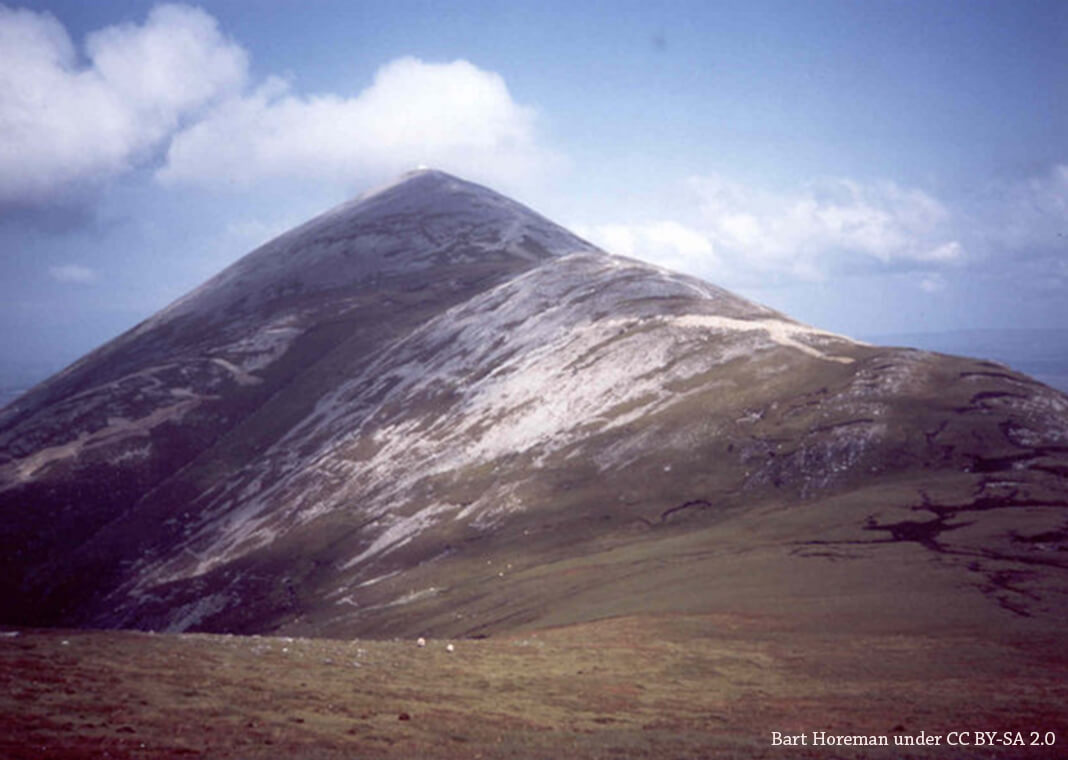
There is a dramatic conical mountain on the west coast of Ireland called Croagh Patrick, where St. Patrick is said to have defeated the druids. Now a popular pilgrimage destination, it is a testing walk up a steep mountain with often wild and unpredictable weather. I was introduced to this walk by Fr. Frank Fahey, a local priest, who resurrected the ancient pilgrim route from Ballintubber Abbey and led many of the walks himself. One of the things he used to say was, “We climb the mountain to get perspective, to look back on our lives and see things clearly.” The humorous rule that he had on the walk was, “No complaining,” or, “Be grateful for all,” so if you had sore feet or fell in a bog hole, you were to say, “Thanks be to God,” and shake it off!
Years later, I was to guide pilgrims on the same walk and give them the same pieces of advice that I had received from Fr. Frank. They always proved to be apt for a pilgrimage: gaining perspective, looking back on life from a higher place, and being grateful. These are key Ignatian concepts and are central to the Examen, or review of the day, one of the Spiritual Exercises of St. Ignatius.
The first step of the Examen is to ask God for light, or try to see things the way God sees them. We need to get ourselves to a “high place” to be able to look back on the journey and see it clearly. This reflection, looking back over experience, helps us to sort out what is genuine and gives direction forward. The end of a day is normally a good time to look back and evaluate the experiences of the day. Inevitably, there are ups and downs, highs and lows, light and darkness. Seeing the day as God sees it is key to appreciating the texture of our experience and noticing where we have been with God or not.
The Examen’s second step is to cultivate gratitude for everything good that has happened. Typically, this involves identifying a few moments of light in the day, and such moments are always present. Crucially, this is felt interiorly as an emotional shift; gratitude changes the heart. However, it often takes work to overcome our habitual negativity and adopt a more hopeful way of seeing. This is probably the most important step, and one needs to feel this interior movement, called consolation in Ignatian language, to be able to move ahead.
Then we can move to the third step of the Examen: watching our day replayed like a movie before us with Jesus beside us. Seeing it as he sees it, we realize the wonder of how God is alive in the world. We come to know exactly how we have been cooperating with God or not. With practice, we can feel or get a sense of what was good and genuinely from God and the opposite.
That leads to the fourth step: asking forgiveness for mistakes, learning from them, and moving on. This fuels our commitment to living the next day in a more aware, discerning, and proactive way. This final step, then, means committing concretely to act better in the future.
The Examen takes practice and patience, but it works effectively over time to make our Christian commitment a reality in terms of how we act and decide. It is a journey we walk with God in reflection and gratitude, as Fr. Frank often reminded me.
Image by Bart Horeman under CC BY-SA 2.0.


Thanks. Gaining perspective, looking back on life from a higher place, and being grateful. Beautiful stuff. The Reverend Brendan has offered an enjoyable path forward to pilgrims on the march.
Great stuff Brendan!
Thank You