


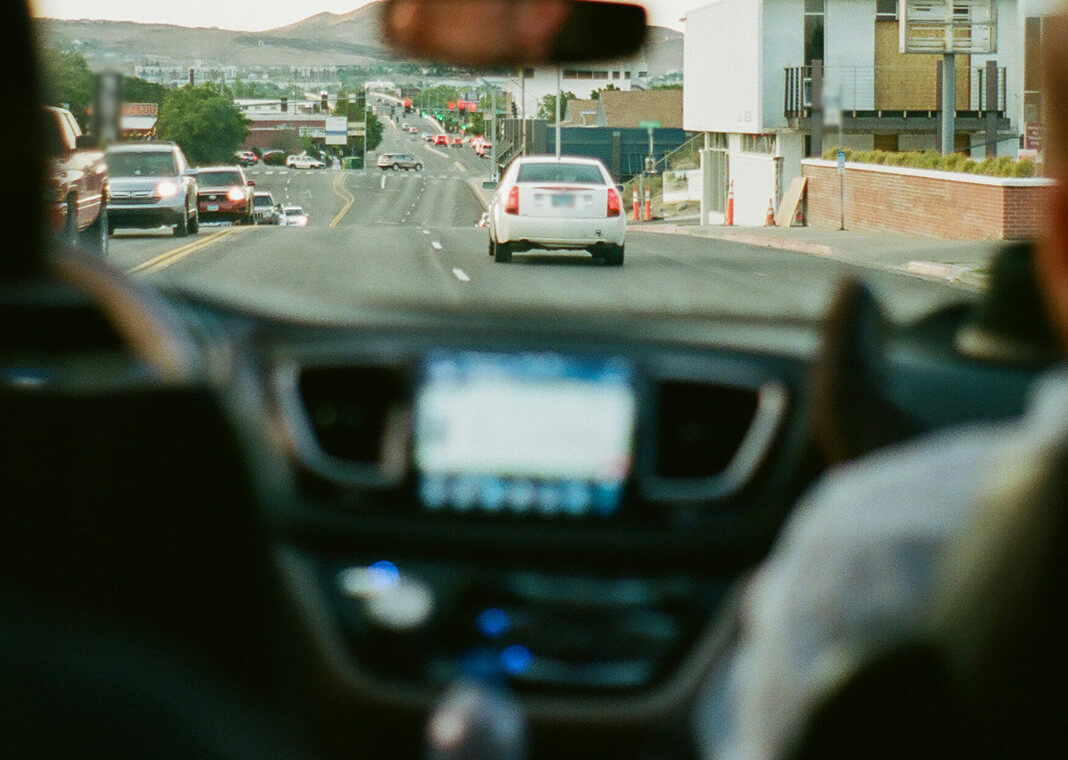
We’ve crossed a new threshold in life, which is to say, we’ve recently bought a van. Our two girls were absolutely giddy at the prospect of no longer having to sit in the same row.
But how quickly the giddiness fades.
“I can’t hear the music!” the younger one wails. “Turn it up!”
“It’s already so loud,” I protest from the driver’s seat. My wife concurs. “It’s going to hurt your ears.”
My daughter is displeased with that response, crosses her arms, contorts her face into a look of absolute misery, and tucks herself into the side of the seat. I, feeling quite justified in my parental wisdom, shrug.
But as the days pass and driving duties shift—what with all the passengers we can now ferry about—I find myself in the back seat. And, importantly, I find myself straining to hear the music.
“You were right,” I say to my daughter. “It is hard to hear back here.”
She looks at me with the smugness I deserve. And the next time I am in the driver’s seat, I, dutiful father, press all the buttons I can find on the front panel until the sound is balanced appropriately throughout the car and all ears are happy.
In the Ignatian tradition, we talk about the “Ignatian plus sign.” What’s that? In short, St. Ignatius invites us to give one another the benefit of the doubt by way of the Presupposition with which he begins The Spiritual Exercises. We should “be more eager to put a good interpretation on a neighbor’s statement than to condemn it.” (#22)
Sometimes, though, we think we already have put our best interpretation on another’s statement. We think we understand that person’s perspective just fine. We are convinced that our way is correct, and no further work is required.
That is, until we put ourselves in our neighbor’s shoes. Suddenly, we see much more clearly—or, in my case, hear much more clearly—the unique place from which our proverbial neighbor’s statement originated.
In the Presupposition, Ignatius implores us to “search out every appropriate means” through which we may, in charity and truth, engage the words of our neighbor. That might mean doing more than simply thinking about those words; it might mean getting up and getting out and trying to encounter the place and the people from which they came.
It might mean riding along in the backseat instead of the front.
In the end, my daughter was right, and I was wrong. But I was only able to know that by sitting next to her and experiencing the car ride through her ears. Because I did, we were able to make changes in the car that improve the experience for everyone.
Would that we could make such changes through such fruitful encounters in all areas of our lives.
Photo by Marc Pagliuca on Unsplash.


Just another way of saying; “Walk a mile in another person’s shoes.” But one so important if we as a people are going to get along and follow in the footsteps of Christ. Thanks for enlightening me and broadening my perspective.
John “B”
Thanks Eric. Yet again a real and thought-provoking contribution.
Putting a good interpretation on a neighbor’s statement requires tons of love and goodwill towards God’s creation.
Accumulating inner strength through prayer, reflection, meditation, contemplation, and acts of genuine love does help to reduce the instant urge to condemn, criticize, and disqualify anything and everything that appears different and disturbing.
When recuperating in the hospital bed, the wounded soldier Ignatius had long stretches of time with the Lord. It is there the convalescing future saint developed his spiritual repertoire which has become a wisdom bank.
Generations of spiritual seekers have been benefiting from the Ignatian way of proceeding.
Hello Eric…As a Father of Triplets (Sarah, Danielle and Ryan) I so relate to “commands from the back seat of the van”. In our case it was usually three different demands for a radio station by each kid. As a contracts lawyer my negotiation skills were regularly challenged. We “agreed” that each kid could select their radio station for 15-30 minute intervals. It mostly worked until the argument started about whose turn it was to pick the station! As my wife, Paula and enter our 70s, God’s wisdom and life experiences enable us to see life in new ways, particularly when our kids ask that preverbial question “HOW did you do this with triplets?” Paula and I knowingly chuckle saying “We prayed constantly”. We always tried to keep God at the center of our family. I can’t help but feel a small sliver of accomplishment the kids and grandkids pray before every meal, a tradition handed down from my parents.
It may seem small, but there is another lesson we persistently worked on with our kids: It’s not important that we be “right” on any given topic since to be “right” someone else is made “wrong”. If you asked my kids today about whose right and whose wrong, they’s say “Life is not right or wrong, it’s what you work out”. That’s not my wisdom, it’s God’s. Love others as he loves others. No room for righteous in that wisdom.