


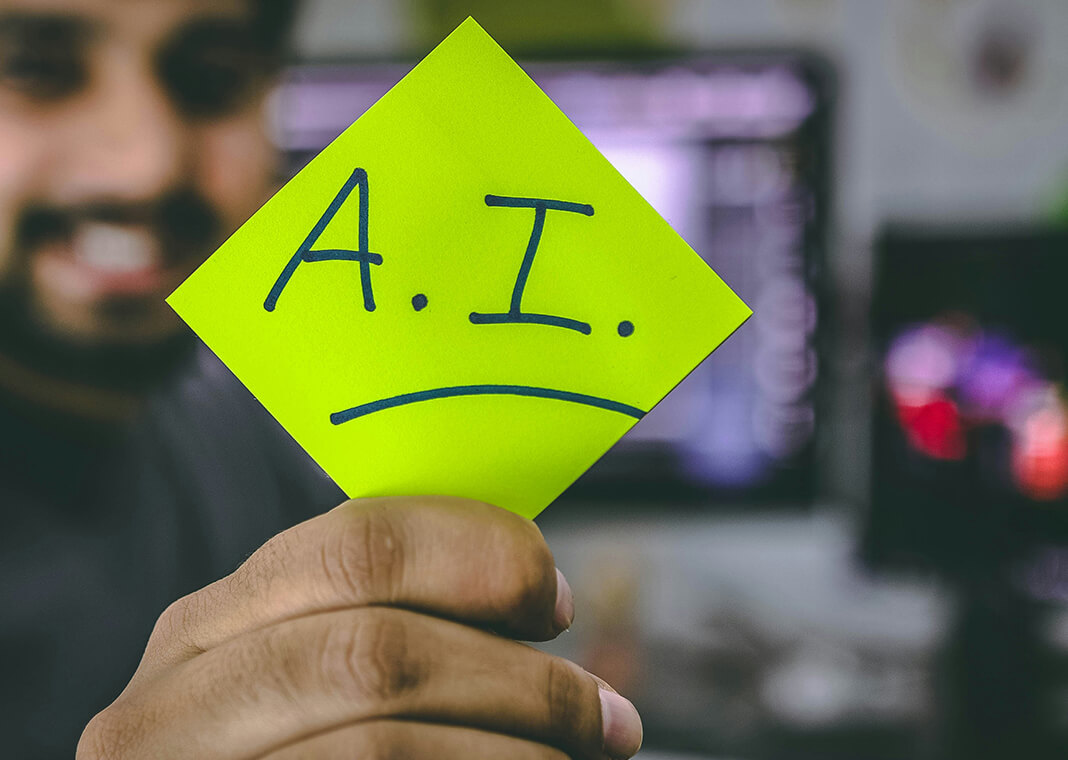
“Ugh! Not again!” I shouted, exasperated. “This stupid pop-up won’t go away!”
“Um, are you OK?” a quiet voice asked.
I jumped, having forgotten I was not alone. While I was trying to generate slides quickly for an upcoming retreat session, a young colleague was testing out microphones nearby. Three hundred retreatants were about to rush back in, and the pressure was definitely on to get everything ready before they did.
I took a second to recover before saying, “Yes. I’m so sorry! This program keeps asking me if I’d like to have AI help me make my work better and more efficient, and no matter how many times I click ‘no,’ it just keeps popping up!” He looked at me curiously, “But clearly you are pressed for time. Why don’t you want AI’s help?”
It was a reasonable question. Why wouldn’t I want the help of a tool that might make this moment easier? Still, I clicked “no” once again and continued my prep without answering my colleague.
Later when the retreatants left for small groups, he asked again, “Why are you resisting AI’s help?” As a graduate student, he had been engaging in conversations in class about the pros and cons of AI use, which naturally sparked his curiosity.
“The truth is,” I told him, “I love technology. I use every advance I can to make my work better. I always have. But when it comes to AI, I’m conflicted.” I paused reflectively, “It’s just that it took me so long to find my voice, I don’t want to lose it now.”
We then began a fruitful conversation. I explained that I spent many years uncertain as to who God was calling me to be. Engaging in the Spiritual Exercises helped me get to know my voice as a writer, speaker, and creator. “When I create something from nothing, I feel like I am using the unique gifts God has given me to serve the world. Therefore, I feel challenged by something that pops up again and again claiming that it can be me better than I can.”
He explained how excited he was about the possibilities of AI helping with advances in medicine and diagnostics as well as being a tool to make complicated information more accessible. I agreed those were valuable advancements, but I still wondered about losing part of our humanity in the process. We both noted a tendency to go to one extreme or the other with AI use, either to reject it completely or embrace it without reservation. We left the conversation reflecting on how to achieve a middle ground.
Pope Leo XIV offered some advice in his Message for the 60th World Day of Social Communications. He said, “Embracing the opportunities offered by digital technology and artificial intelligence with courage, determination and discernment does not mean turning a blind eye to critical issues, complexities and risks.” He suggested three pillars to help guide our use: responsibility, cooperation, and education. He stressed that we need to embrace new technological advances with both discernment and reflection. Perhaps instead of simply clicking “no” to every offering of help AI makes, I need to explore this tool so that I can do my part to help orient these technological advances toward supporting creation and the unique talents gifted to human beings by our Creator.
As I seek the middle ground with this new and fast-moving tool, here are the questions I’m asking myself:
- Am I responsibly using this tool for the betterment of myself and others? Am I open to continuous formation so I can help my community do the same?
- Am I practicing cooperation in my discernment process by listening to the voices of my colleagues, students, and children when it comes to AI?
- Am I open to finding new ways to educate myself and others about the opportunities, challenges, and ethics of AI? Can I help others discern what sources are reliable and trustworthy, as well as how and when to use this tool?
How are you using discernment in your use of AI tools?
Photo by Hitesh Choudhary on Unsplash.


Gretchen,
You have opened the conversation about AI in such a beautiful Ignatian way with this post. The central question (one of many) is: Can a machine be programmed to have a conscience to promote a spirit of deep spiritual goodness that we humans strive to live by as members of the human family and followers of Jesus? Thanks too for sharing some wisdom from Pope Leo.
Rob
Thanks. AI is a beautiful tool waiting to be evangelized. The developers of the tool too are wonderful people in need of being sensitized and conscientized. Fostering human dignity and discouraging a mad rush for accumulating perishable earthly burdens is always comfortable for pilgrims on journey.
Thank you. I felt alone in not being afraid and explore various technology for a better world for all, but not without knowing that they are risks as with a lot of things.
Thank you. A new way for me to view AI